

ERP for auto component makers in India: OEM schedules, PPAP and IATF records, lot traceability, job work, rejections and on-time delivery, with a chec...
Quick answer: An ERP for auto component manufacturers plans production and purchase from OEM schedules, tracks every lot from raw material heat to dispatch, keeps PPAP and IATF 16949 quality records linked to parts, controls job work like heat treatment and plating, and handles line rejections, debit notes and price revisions. The best ERP for Indian Tier-1 and Tier-2 suppliers improves on-time delivery and PPM without adding paperwork.
Published: 13 November 2026 · Written by Riya Agarwal, Pothera ERP
Supplying an OEM is a game of reliability. The schedule changes every week, the line can't stop, every part must be traceable, and the supplier rating arrives every month whether you were ready or not. Most auto component makers in India still plan from Excel, keep quality records in files and find out about a shortage when the truck is already late. That is where premium freight, line rejections and lost business come from.
This guide is for owners, plant heads and quality heads of auto component manufacturers in Pune, Chennai, NCR, Hosur, Bengaluru, Aurangabad, Rudrapur and Sanand. It covers what an automotive ERP must do, the numbers it should improve, how the options compare and what to ask in a demo.
Short on time? Book a 30-minute demo and we'll run one of your OEM schedules through Pothera ERP, from MRP to dispatch.
| Reality of OEM supply | What it means for ERP |
|---|---|
| Monthly schedules with weekly or daily releases | MRP and production plans that update when the schedule changes |
| Strict delivery windows and line-stop penalties | Dispatch planning against schedule, shortage alerts before they become late trucks |
| Traceability expectations | Lot, batch and heat numbers carried from inward to dispatch |
| PPAP, APQP and IATF 16949 | Controlled part revisions, inspection records and audit trails |
| Outside processes | Job work challans for heat treatment, plating, painting and machining |
| Line rejections and debit notes | Rejection records by part, lot and reason, linked to customer debit notes |
| Raw material price-linked revisions | Price amendments with effective dates and supplementary invoices or credit notes |
| Customer-owned tools and dies | Tool and die records with shot or stroke life and maintenance |
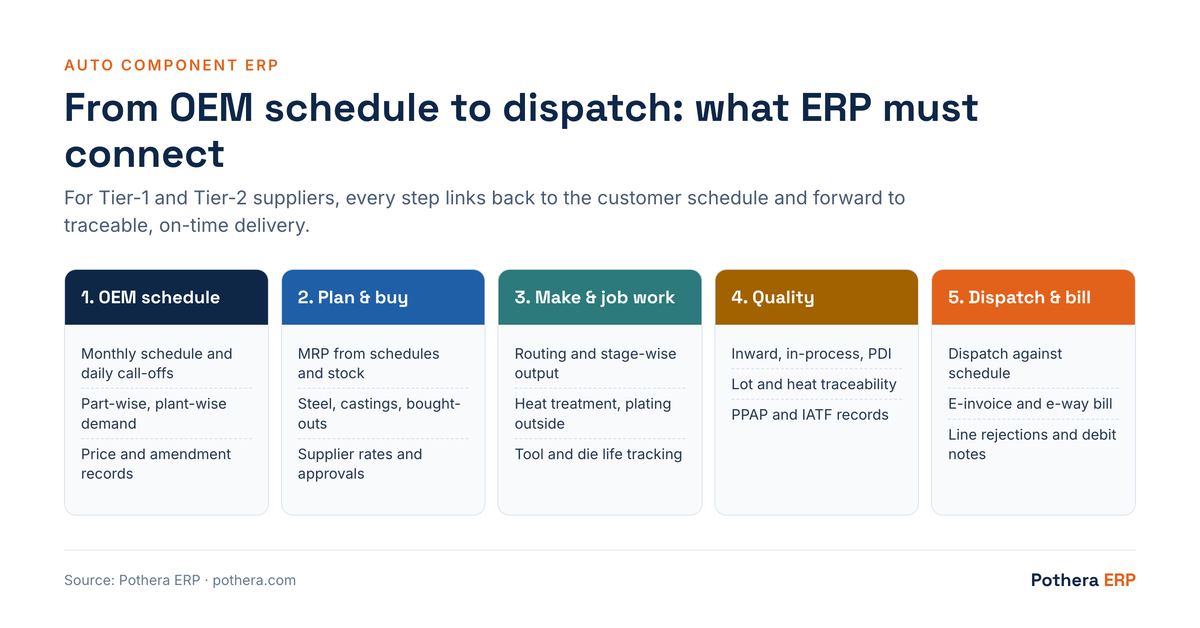
Load monthly schedules and call-offs part by part and plant by plant, with price and amendment history. Sales, planning and dispatch all work from the same numbers.
MRP calculates steel, castings, forgings and bought-out parts from schedules, BOMs and stock, and raises purchase indents automatically. Pothera ERP supports multi-level BOMs, automatic indents from forecast and reorder levels, quotation comparison and supplier-wise rates.
Production orders follow routings and stages, with output, scrap and rework recorded by machine, shift and operator. Material sent for heat treatment or plating moves through job work challans, with reconciliation of what comes back and alerts on overdue material. See job work in Pothera.
Inward, in-process and pre-dispatch inspection with rejection reasons, lot traceability, and controlled part revisions. Read how ERP organises PPAP documentation to cut approval delays.
Dispatch against the schedule, invoices with automated e-invoicing, e-way bills, and records of line rejections and customer debit notes, so every rupee deducted by the OEM is visible.
Losing money to premium freight or line rejections? Ask for a free supply review. Share one month of schedules and dispatches, and we'll show you where delays start.
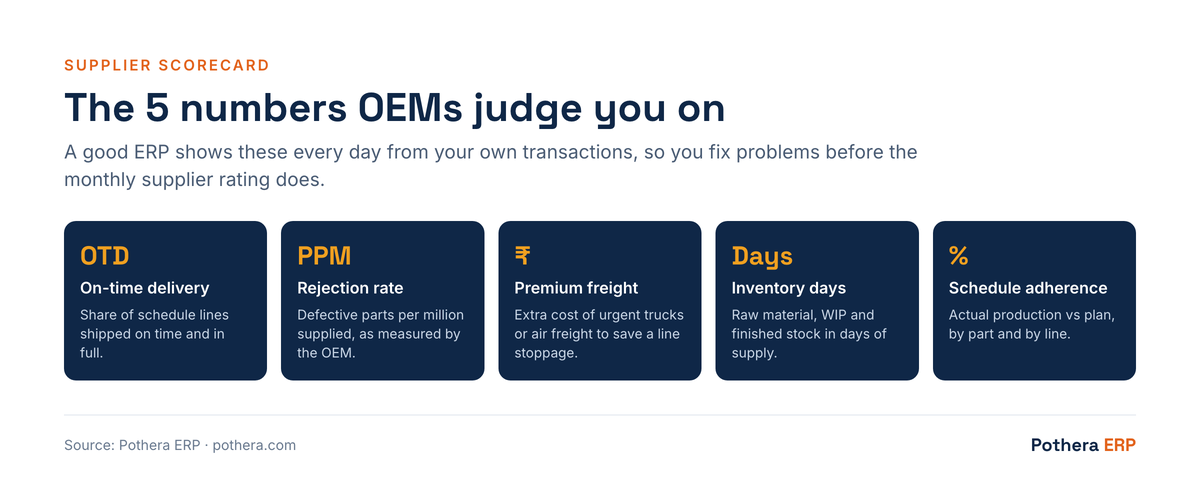
When these come straight from ERP transactions, you see problems daily instead of in the monthly supplier rating.
| Feature | Why it matters |
|---|---|
| Schedule-driven MRP | Plans material and production from changing OEM demand |
| Multi-level BOMs and revisions | Every plant builds the approved revision; engineering changes are controlled |
| Routings and stage-wise tracking | Shows where each part is and what it is waiting for |
| Lot, batch and heat traceability | Answers customer complaints and audits quickly |
| Quality inspections and rejection analysis | Cuts PPM by finding repeat causes by part, supplier, machine or shift |
| Job work control | Keeps material at heat treaters and platers visible and on time |
| Multi-plant operations | Plants near different OEMs run on one system |
| E-invoicing, GST and TDS | Compliance without a second software |
| Owner dashboards | OTD, PPM, stock and receivables on one screen |
Pothera ERP covers these, including QR code and digital signature integration, multi-plant setup, and machine, shift and operator-wise production analysis. Pothera is used by Alpine of Asia Pacific India, which makes auto components, sensors and communication modules for automotive and consumer electronics markets.
Details are based on each product's public information as of November 2026. Always confirm in a demo.
| ERP | Best for | Strengths | Check before buying |
|---|---|---|---|
| Pothera ERP (Bsquare Solutions, Noida) | Small and mid-size Tier-1 and Tier-2 suppliers | MTO, MTS and mixed production, quality, lot traceability, job work, revisions, e-invoicing. Cloud, on-premise or hybrid. | Ask for a reference in your process type |
| Udyog ERP | Indian auto component makers | Promotes OEM schedule alignment and APQP and PPAP support | Scope and pricing for your plants |
| Sage X3 and Sage partners | Mid-size manufacturers | Established ERP, partners pitch auto component templates | Partner experience and customisation cost |
| SAP Business One | Suppliers wanting a global brand | Strong finance and inventory through partners | Shop floor and quality depth via add-ons |
| Odoo | Tech-friendly SMEs | Modular manufacturing and quality apps | Support and Indian compliance customisation |
| Tally Prime | Very small job shops | Accounts, GST and basic stock | No schedule-driven MRP, quality or traceability |
The best ERP plans from OEM schedules, tracks lots end to end, keeps quality and PPAP records linked to parts, and controls job work and rejections. Pothera ERP, Udyog ERP, Sage partners, SAP Business One and Odoo are common choices. Compare them using your own schedules.
Yes. ERP keeps the records IATF 16949 audits check, such as controlled revisions, inspection results, traceability, supplier performance and corrective actions, complete and easy to retrieve. Certification also depends on your quality system and processes.
Yes. A good automotive ERP converts schedules and call-offs into material requirements and production plans, and updates them when the schedule changes.
By recording inspections and rejections by part, lot, supplier, machine and shift, ERP shows repeat causes quickly, so corrective actions target the real problem.
Yes. Pothera ERP issues material through job work challans, reconciles what comes back including scrap and loss, and alerts you when material is overdue.
Yes. Tier-2 suppliers face the same delivery and quality expectations as larger ones. A cloud ERP with core modules keeps the starting cost manageable.
Bring one OEM schedule and last month's dispatches. We'll show you the plan, shortages and OTD in Pothera ERP. Book your demo.
Related reading: PPAP documentation with ERP · ERP for electronics manufacturing · Best ERP for manufacturing in India · Manufacturing scheduling ERP