

Tally vs ERP explained simply: what Tally does well, where it stops, 8 signs you have outgrown it, what changes after switching and how to migrate saf...
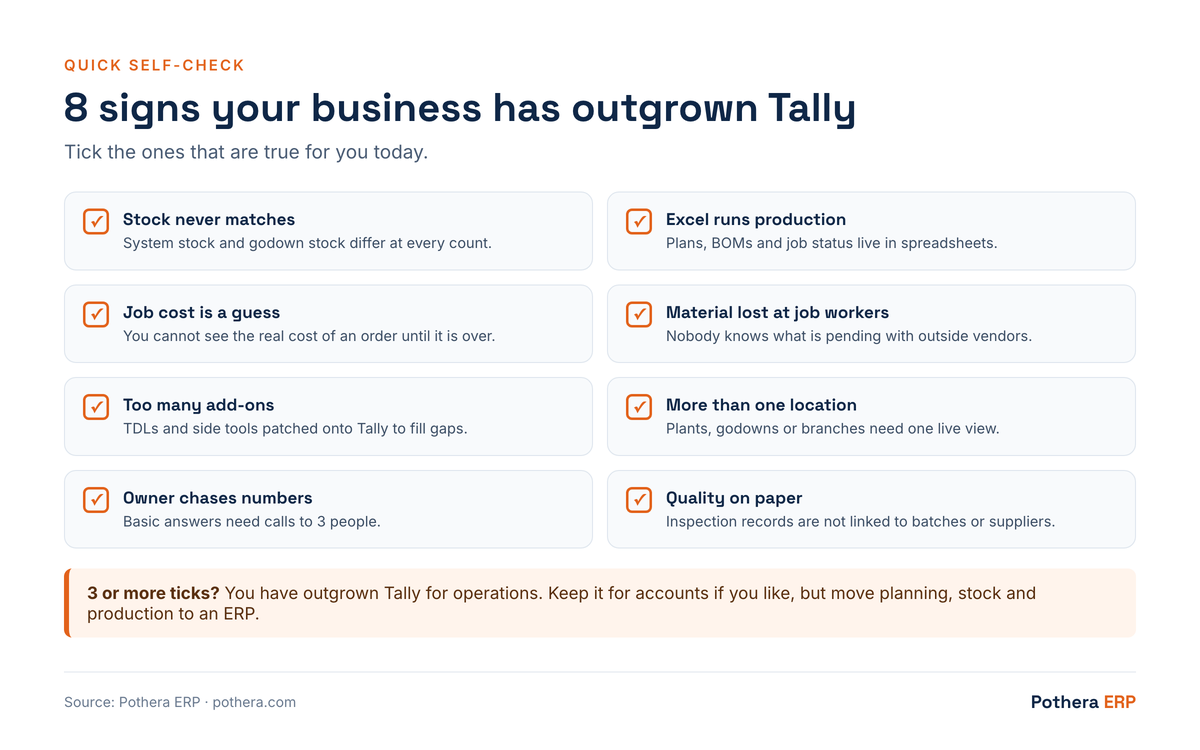
Quick answer: Stay on Tally if you mainly need accounting, GST and simple stock. Switch to an ERP when you need production planning, job work control, quality records, approvals or one live view across several plants and godowns, or when Excel sheets and add-ons have grown around Tally to fill the gaps. Many businesses switch when three or more of the warning signs below are true.
Published: 13 November 2026 · Written by Riya Agarwal, Pothera ERP
Tally is one of the best things that happened to Indian business accounting. It is fast, reliable and every CA knows it. That is exactly why businesses stay on it long after their operations have outgrown it. The signs are familiar: production plans in Excel, stock that never matches, job work tracked in a register, and an owner who has to call three people to answer a simple question.
This guide gives an honest answer to a common question: Tally or ERP? It explains what Tally does well, where it stops, the signs that it is time to move, what actually changes, and how to switch without disrupting the business.
Not sure where you stand? We will look at how you use Tally today and tell you honestly whether you need an ERP yet.
Book a free 30-minute assessmentFor a trader, a shop or a small unit with simple processes, that is often enough.
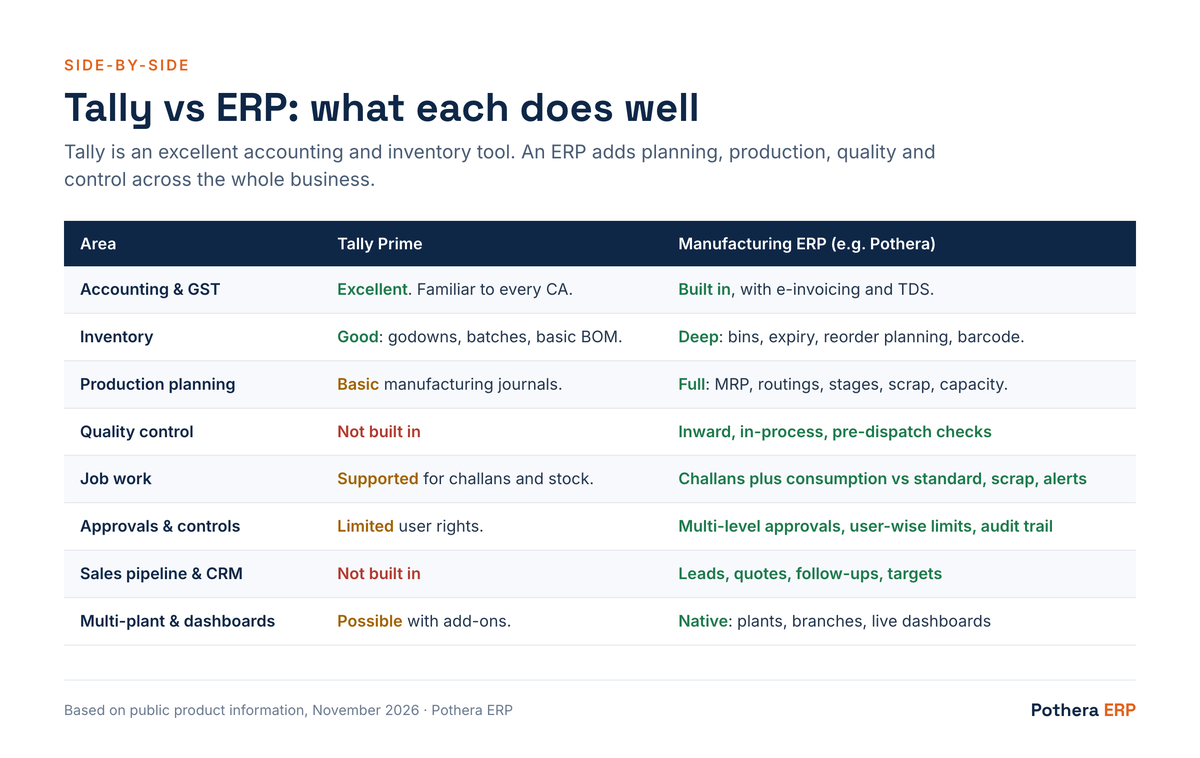
| Area | Tally Prime | Manufacturing ERP (such as Pothera) |
|---|---|---|
| Accounting and GST | Excellent, familiar to every CA | Built in, with e-invoicing, GST and TDS |
| Inventory | Good: godowns, batches, basic BOM | Deeper: locations, expiry alerts, reorder planning, barcode and RFID |
| Production planning | Basic manufacturing journals | MRP, multi-level BOMs, stages, scrap, machine and shift analysis |
| Quality control | Not built in | Inward, in-process and pre-dispatch inspection with rejection analysis |
| Job work | Challans and stock movement | Challans plus actual vs standard consumption, scrap return and due-date alerts |
| Approvals and control | User rights | Multi-level approvals, user-wise transaction limits, audit trails |
| Sales pipeline and CRM | Not built in | Leads, quotations, follow-ups, targets and after-sales service |
| Multi-plant and dashboards | Possible with add-ons and customisation | Native plants, branches and live dashboards |
Details for Tally Prime are based on public product information as of November 2026.
Before and after: keep scrolling to see each card turn
Confirming an order
Call the godown to check stock
Confirming an order
Live stock, reserved stock and production status on screen
Buying material
Purchase from memory or a sheet
Buying material
Automatic purchase indents from orders, stock and reorder levels
Tracking production
Phone calls to the floor
Tracking production
Order-wise progress by stage
Job work
Register and follow-up calls
Job work
Pending material by vendor with overdue alerts
Product costing
Estimated once a year
Product costing
From actual material, scrap, labour and overheads
Month-end
Days of reconciliation
Month-end
Stock and accounts already match
Ticked three or more signs? We will review your item masters and tell you how long a switch would take.
Get a free readiness checkYes, there are two common paths:
Avoid running both systems for the same transactions for long. Double entry is where errors and mismatches start.
The software is usually the smaller part. The cost depends on users, modules, plants and implementation work such as data cleaning, migration from Tally and training. Cloud ERP is paid yearly per user; on-premise needs a licence plus annual support. Ask for a quote that lists software, implementation, data migration, training and support separately. For a manufacturer, a single avoided stockout, lost job work lot or under-priced order often covers a large part of the first year's cost.
Tally Prime is mainly accounting and inventory software with some manufacturing and job work features. It is not a full ERP for production planning, quality, approvals and multi-plant operations.
Switch when you need production planning, job work control, quality records, approvals or one live view across locations, or when spreadsheets and add-ons have grown around Tally to fill gaps. Three or more of the warning signs usually means it is time.
Yes, during a transition. Many businesses run operations on ERP and keep Tally for final accounts for a while. Avoid entering the same transactions in both for long.
Most small and mid-size businesses go live in 6 to 12 weeks. Clean item masters and opening balances make it faster.
No. Masters, opening balances, open orders and stock are migrated at go-live. Older history stays available in Tally for reference and audits.
Not necessarily. Cloud ERP with core modules keeps the starting cost low, and the savings from fewer stockouts, accurate costing and faster month-end often cover it.
Ready to find out? Send us a short note on how you use Tally today. In 30 minutes we will tell you honestly whether you need ERP yet, and what a switch would look like.
Book your free assessmentRelated reading: ERP for small manufacturing businesses · Inventory management software · ERP for wholesale distributors · Advantages of ERP systems